Generational Thinking in Automation

Beumer Group is a familiar presence at LogiMAT. Corporate Comms Manager Jonas Jungmann spoke to Logistics Business Features Editor, Paul Hamblin, about the company’s products, plans and ethos.

Let’s start with new products – tell us about the new BG Pouch System with AutoDrop function. Specifically, how will it improve operations for customers, and what benefits can they expect?

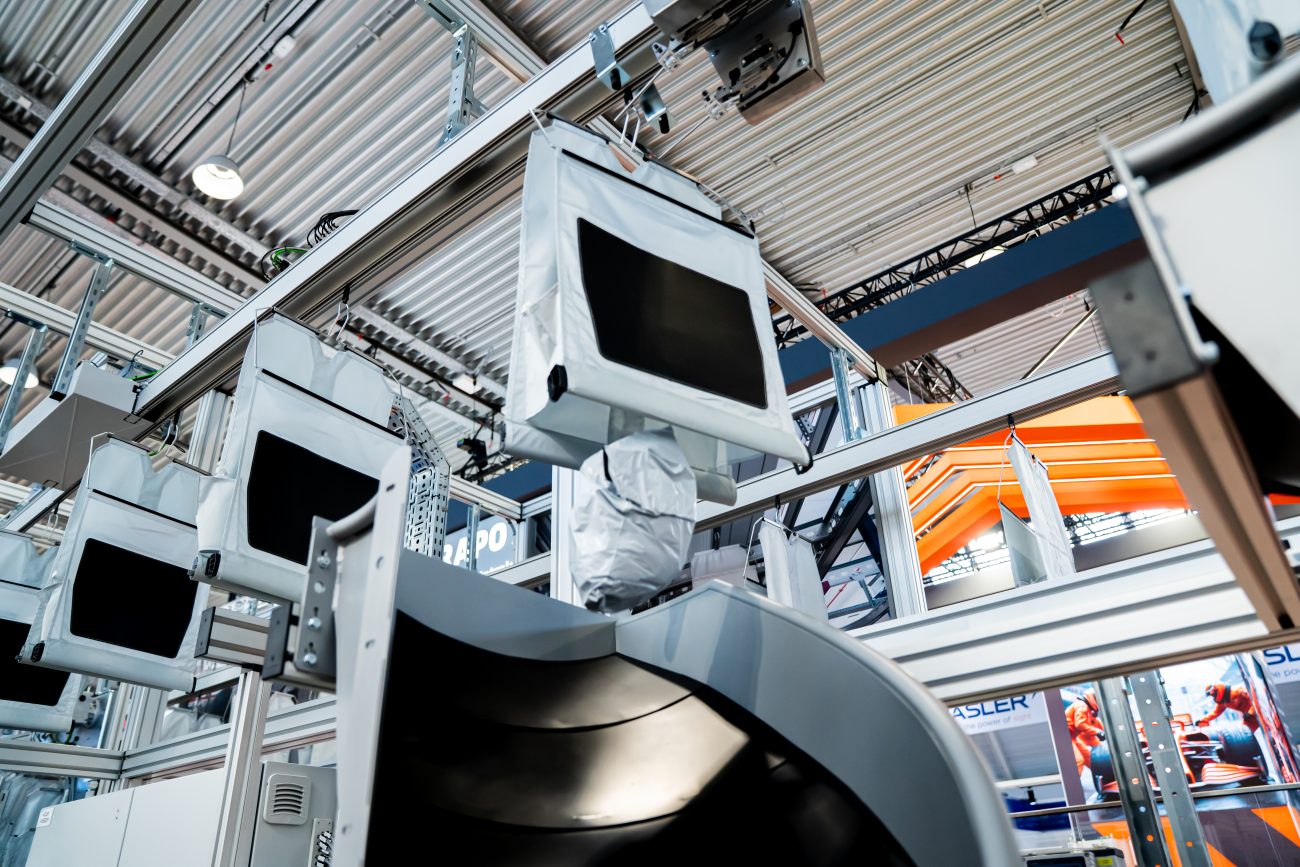
BG Pouch System with AutoDrop enables fully automatic and contactless unloading of pouches. It is ideal for single-unit handling, but is also capable of combining items in any desired sequence. This improves distribution and reverse logistics across multiple fulfilment and returns operations.

For example, the system can fulfil store replenishment orders to fit the store’s specific layout, increasing productivity and freeing up staff for customer service. It easily accommodates value-added services, such as placing gift cards or greeting cards in an order. It also achieves fast, automated reworking of returns, making items immediately available for resale and significantly reducing handling time and costs.

BG Pouch System with AutoDrop requires approximately 30% less space than conventional picking systems and can be mounted in the ceiling, saving valuable floor space. The modular design also allows the system to be scaled up quickly and easily as needed.
You’re known for pallet packaging technology. What are the benefits of Beumer‘s Stretch Hood technology?

Our patented Stretch Hood is a custom-designed, automated end-of-line solution for packing pallets economically, safely, and automatically. The technology uses cold-stretchable films, which eliminates heat exposure and air-cooling to achieve very low operating costs. It can be implemented as an integrated or stand-alone system and is suitable for diverse applications, from high-value electronics to construction materials.

It offers security, protection, efficiency and versatility. The seal prevents tampering and pilfering, with any attempt to undo the seal being immediately evident. The technology guards against moisture, dirt ingress, spoilage, and damage during storage and transit. Efficiency results from the repeatable accuracy and consistency enabled by automation, also minimising the scope for human error in the critical final packaging phase.

It also has the versatility to apply transparent film for visibility or opaque film for high-value goods where security is paramount.

You’re bringing an Innovation Corner to LogiMAT in March. What can visitors expect from this?

Our Innovation Corner at LogiMAT will showcase the latest advances in robotics, software, and data analytics. This space highlights how cutting-edge technology and proven products combine to deliver real value for intralogistics.

Visitors can explore scalable solutions for warehouse and distribution operations, gain insights into digital transformation strategies, and engage directly with Beumer experts on future trends. The Innovation Corner reflects our broader Innovation Centre concept, which drives R&D and continuous portfolio development to meet evolving industry needs.

Let’s move on to the Customer Diagnostic Centre and its role in optimisation and predictive maintenance. What does that mean in practice? Can you give specific examples of what it does and how operators can deploy it?

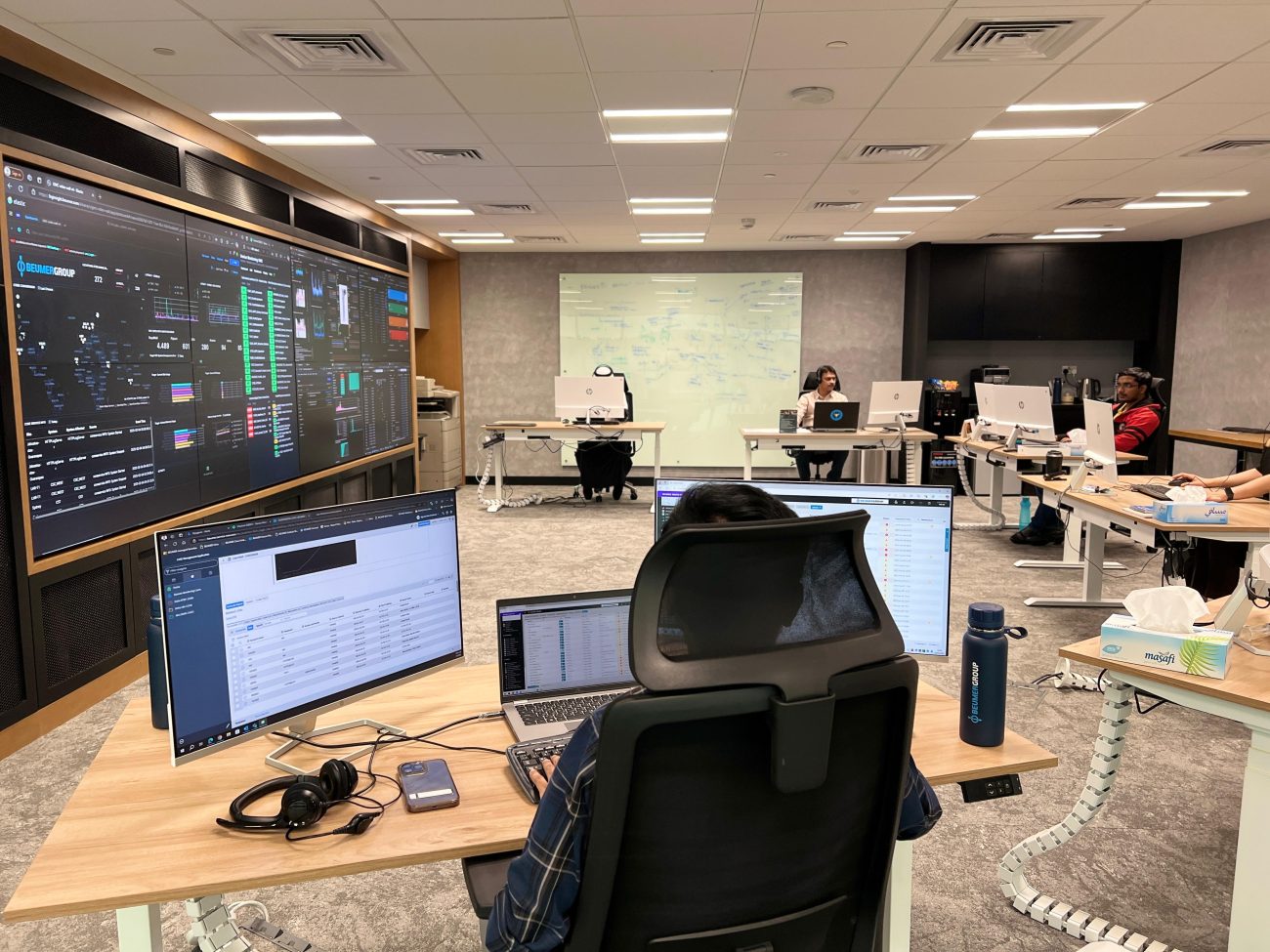
Analysing and interpreting operational data is a complex and resource-intensive task that requires serious investment, which can detract from your core business. Beumer Group’s Customer Diagnostic Centre offers logistics companies access to data-driven services and expertise whenever they need it.

Our diagnostic experts monitor and analyse your operational data, anticipate issues and act proactively, remotely or on-site, to support predictive maintenance, process optimisation, and system diagnostics. Individual services range from an emergency hotline to cybersecurity support and can be used in any combination to meet customer needs.

In one instance, data analysis revealed that a customer had unused capacity of 40%, even though they believed they were at their operational limits. Guided by the results, the customer was able to implement efficiencies and meet continuing demand without the need for a major expansion.
You have recently announced new manufacturing facilities in China and India. Could this negatively impact the perception of Beumer as a premium European manufacturer?

Our China and India facilities have been developed to manufacture in line with Beumer’s global standards, ensuring equally high levels of quality and engineering excellence. The high-tech plants are integrated into our worldwide manufacturing network and run by trained teams, delivering the craftsmanship and reliability customers expect from our brand. These sites bring us closer to regional customers, enabling faster delivery and support.

You describe your strategy as “value-driven.” What does this mean in practice for customers?

Our four values – reliable, down-to-earth, ambitious, collaborative – guide decisions and build trust-based and long-term relationships. We never cut corners: we promise only what we can deliver, so systems perform reliably for years. We prioritise long-term partnerships over one-off deals; our customer support accompanies clients across the entire equipment lifecycle. In short, being value-driven aligns every action to create sustainable success, placing trust, superior quality, and long-term outcomes over quick wins.

What is BEAM and what is it for? Can you tell us about recent success stories and what they bring to the Group?

BEAM, launched in 2018, is Beumer’s startup incubator and innovation engine. It systematically builds new, digital business ideas that complement our intralogistics portfolio. We partner with entrepreneurs and internal experts, providing industry know-how, funding, and a safe space to scale.

Two startups now integrated into Beumer are Codept and Elara. Codept (founded 2019) offers a cloud-based logistics integration platform connecting online retailers with 3PLs, streamlining data exchange across shops and warehouse systems and drastically reducing onboarding time and IT effort. Elara (started 2020) is a cloud-based maintenance management software for centralising assets and service activities, enabling predictive maintenance to prevent downtime, optimise spare parts, and lower operating costs through transparency and data-driven insights. Both expand our digital services portfolio.

I saw an interesting quote from, Dr Christoph Beumer, the former CEO and now chair of the Advisory Board: “As a family business, we think in generations, not quarters”. What does this mean? What decisions can you point to that prove this philosophy to customers and prospects?

We judge major decisions by their decade-long impact on our customers and company. As a family-owned business, we reinvest for sustainable growth and innovation rather than maximise short-term profit. This financial prudence gives us independence to make bold, future-oriented investments, such as new factories in China and India.

‘Thinking in generations’ also shapes relationships: we seek lifetime partnerships, not quick sales. Our customer support team supports every installation for its entire life (and beyond), while customer partnerships and employee development are built on trust and longevity. This approach – proven over more than 90 years – keeps Beumer a reliable, forward-looking partner in a (sometimes) uncertain world, year after year and generation after generation.
Modern-Day Moving Truck

Logistics Business takes a closer look at a ‘workhorse’ truck behind corporate headquarter relocations.

While it may have escaped your attention, more and more companies in have decided to pack it up and ship out to a new and different destination. The commercial real estate industry was upended by the pandemic, with offices clearing out to accommodate the safety and convenience of a new generation of home-based ‘remote’ workers. This mass migration, in turn, triggered a wave of chaotic leasing activity that continues buzzing to this day.

There is well-sourced data from Atlas Van Lines’ recent annual corporate relocation survey, which dates back more than five decades. Among the interesting findings in 2025:

• 63% of respondents shared that they intend to bolster their relocation budgets
• The primary driver of corporate relocations is economic conditions (50%)
• Half of all respondents chose to remain in place rather than consider a move
• Nearly a third of all respondents reported a relocation decision in their immediate future

While some corporate relocations are worthy of splashy headlines, there is an unsung hero working behind the scenes to make it happen – the modern-day moving truck. Noting it’s time for a closer look,
Logistics Business reached out to a company for an up-close and personal look at the workhorse of office moves. Move Solutions, headquartered in Dallas, Texas, is one of the country’s leading corporate relocators, having completed major cross-country transitions for Fortune 500 companies such as Toyota USA, Wells Fargo, and Blue Cross Blue Shield. And it certainly doesn’t hurt that their home base of operations also happens to be the top-rated destination city for HQ relocations.

A Guided Tour…

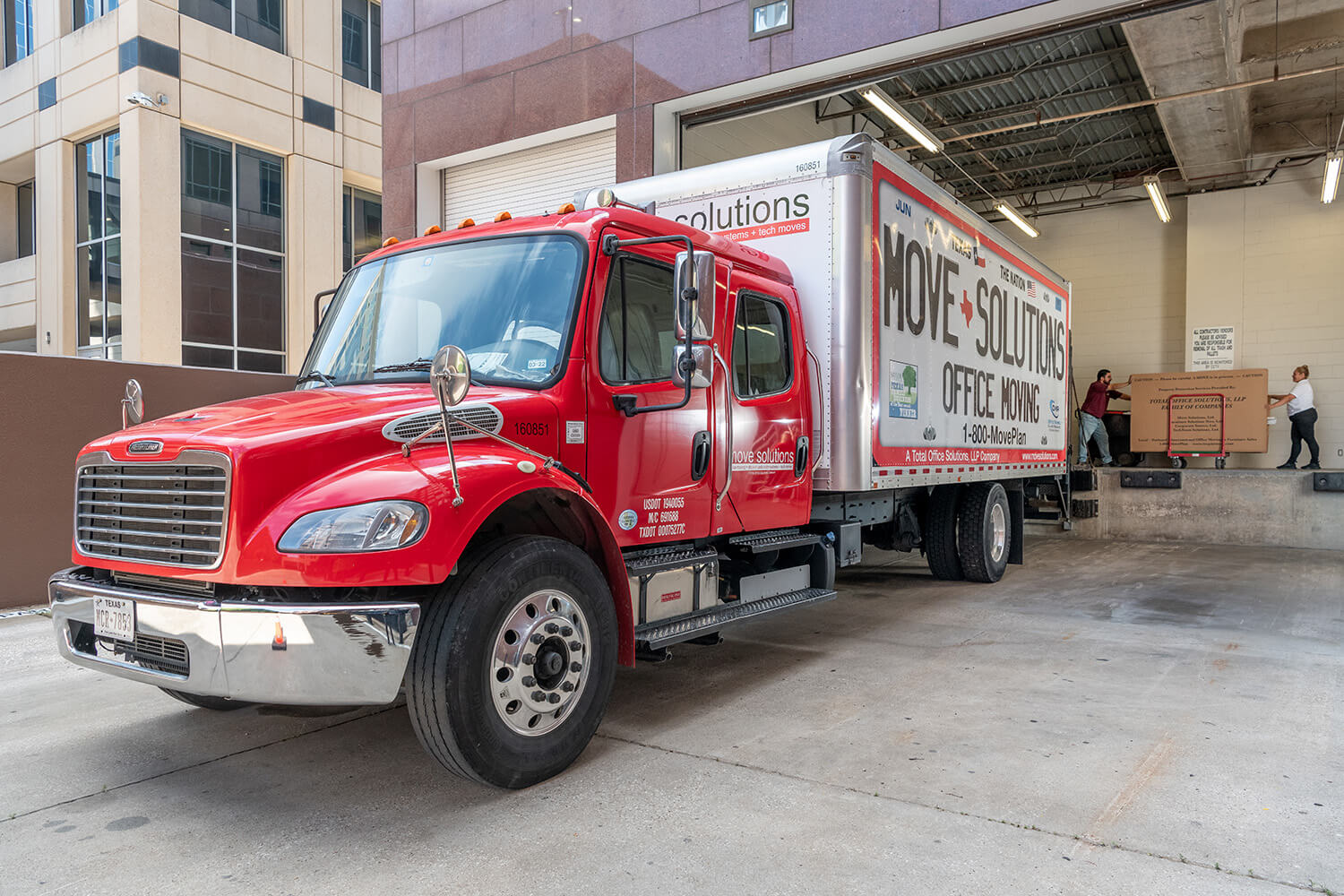
Kurt Fox, director of operations for Move Solutions, provided us with a thorough overview of their transportation standard-bearer for corporate relocations – the Penske 22’ Commercial Box Truck. There are 41 of these trucks in the company’s combined transportation fleet, which also includes twenty-five 14-person passenger vans, ten 18’ cube vans, two 16’ cube vans, and one max-length 53’ tractor trailer for hauling the really big stuff.

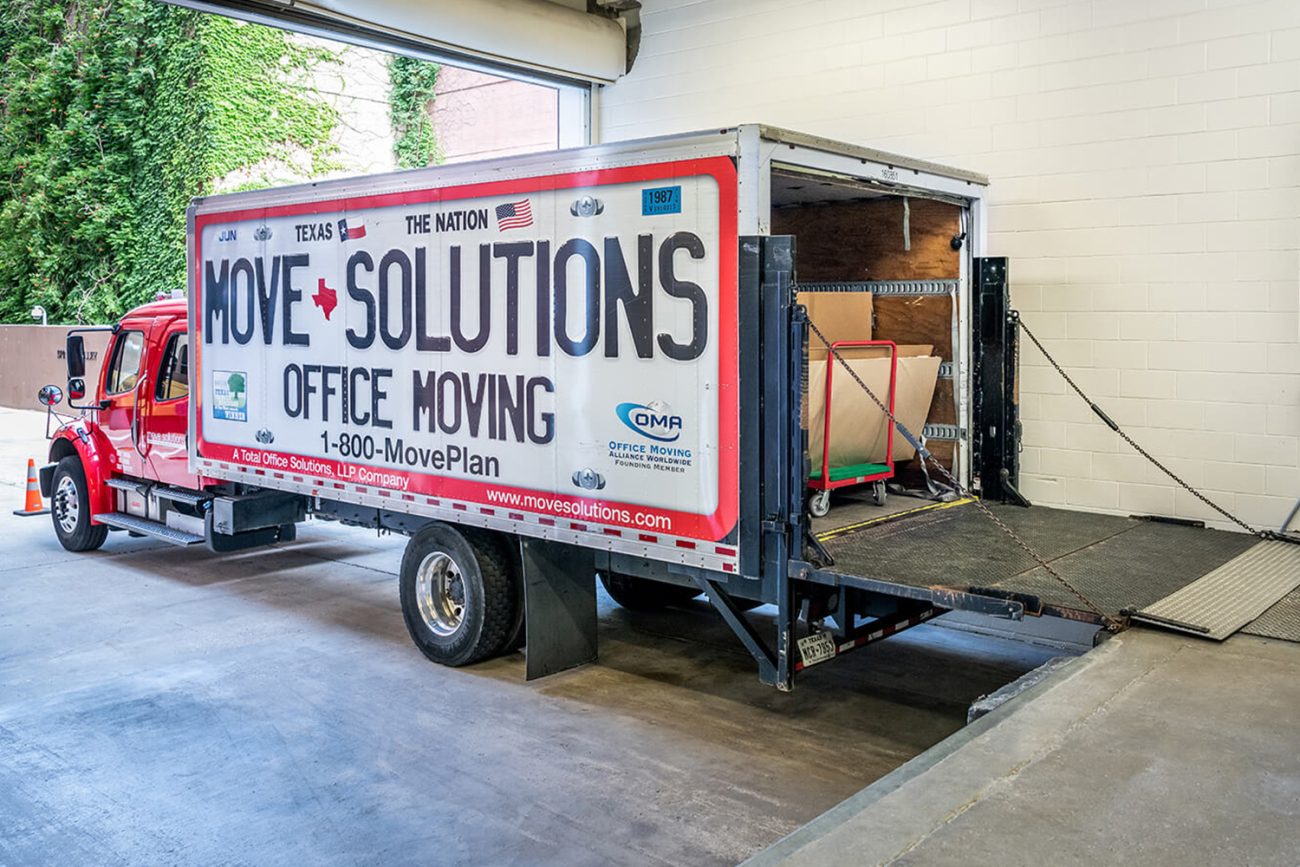
Move Solutions’ vibrant, candy apple red truck cabs seat a crew of five comfortably, and the design is actually patterned after modern-day pump truck-style fire engines for maximum space and efficiency. As for precise specifications, these trucks have body dimension measurements that are 91” high, 102” wide, and interior cargo walls that feature 3/8” plywood lining. They also come standard with a 4000 lb. rail lift, air ride suspension, a double e-track cargo system, interior cargo lighting, and an exhaust regeneration system.

The payload capacity is rated for up to 17,000 lbs., and the trucks feature a 70-gallon diesel fuel tank, with an overall gross vehicle weight of 16.5 tons. As for the engine that powers these beasts, the Penske 22’ Commercial Box Trucks typically operate on a platform that boasts a 6.0-liter V-8 that produce a robust 350hp, rated at 373 lb.-ft of torque, and are capable of getting about 10-12 miles per gallon. Transmissions are six-speed automatic. Despite this awesome display of horsepower and hauling capacity, these trucks are still certified as clean idle vehicles.

Hauling the Mail

When it comes to sheer cargo volume, the Penske 22’ Commercial Box Trucks are capable of hauling up to 10 standard size moving pallets. These are commonly loaded with typical office furnishings such as decommissioned workstations and cubicles, executive desks and task seating, filing systems (with lateral files), IT racks and server cabinets, and other assets.

Corporate relocations are almost always conducted out-of-sight, during off-peak hours where most employees remain blissfully unaware of just how much planning and logistics are involved behind the scenes of your typical office move. Somewhere, some place – perhaps even going on at this moment – a company employing thousands of workers is on the move – stealthily shifting headquarters from Point A to Point B. When it comes to office relocations, Move Solutions CEO Michael Monette likes to describe the process this way:

“We take you out of business. Then put you back in business. And we’ve never failed at that task.”

That task is comprehensive, complex, and every little detail of an office relocation matters, down to the last bookcase, coat rack, and fake plant. But hopefully, you now have a much better idea of the standard-bearing workhorse trucks that make the magic happen in the midst of controlled chaos.

Projected Safety Signage is Safer Option

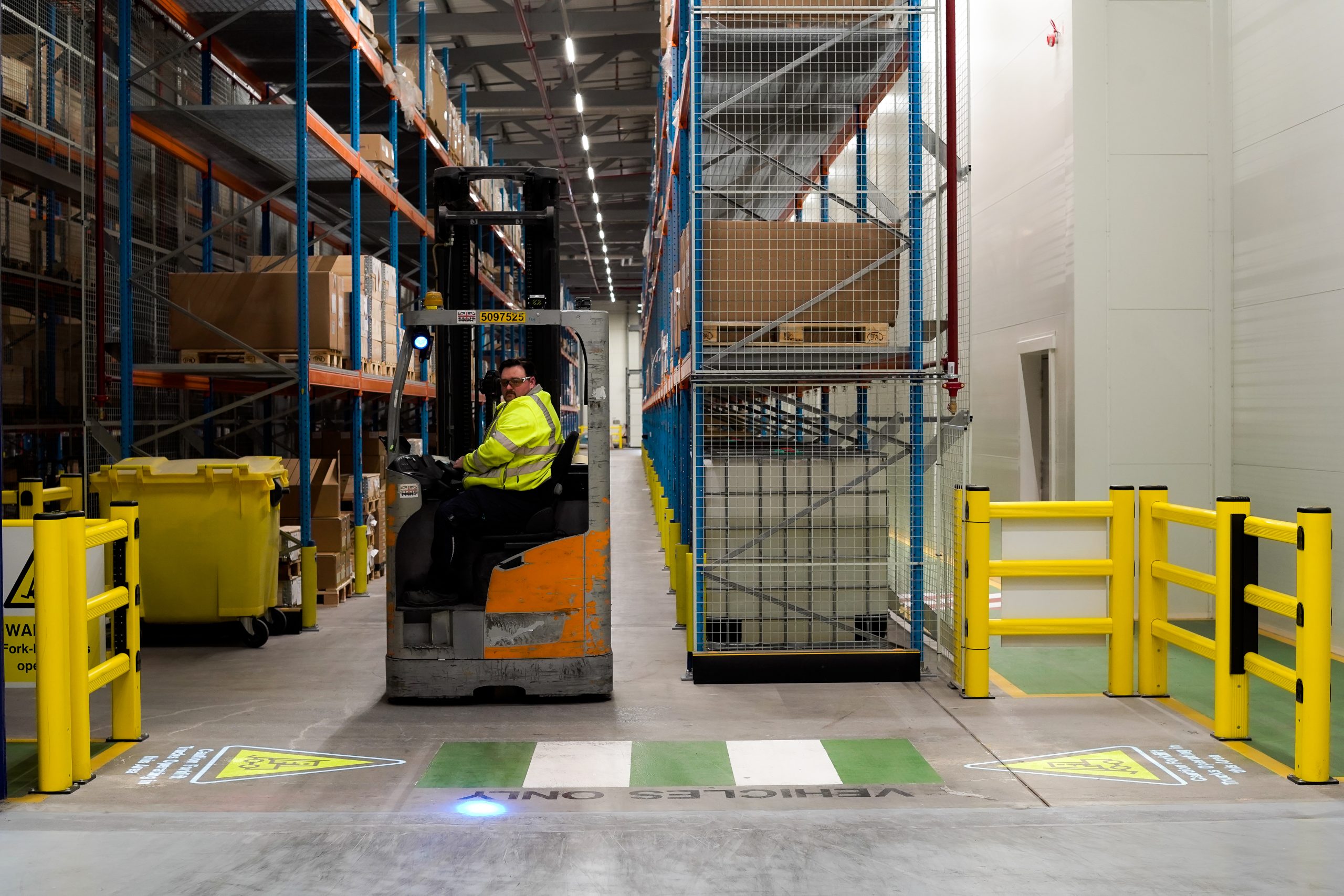
Projected safety signage is helping warehouses and industrial facilities improve forklift safety by reducing ‘sign blindness’ and providing a more durable alternative to traditional safety signs.

In environments with constant forklift traffic, painted and printed signs and floor markings can wear away quickly, becoming faded, damaged or unclear. As a result, critical safety messages can lose impact and require frequent maintenance.

Projected Image says projected safety signage is unaffected by constant forklift movement, offering a longer-lasting – and safer – solution that remains clear even in high-traffic areas.

“The HSE (Health and Safety Executive) estimated that approximately 2,000 accidents involving forklifts were reported in Great Britain in 2018/19, so clear, instantly recognisable safety messaging is more important than ever for facilities using forklifts!” says Ian Spoors, Managing Director of Projected Image.

“While traditional painted or vinyl markings wear and typically require maintenance twice a year, projected signage provides a bright, highly visible image that doesn’t fade or wear under forklift traffic – with a maintenance-free five-year lifespan.”

By projecting sharp, vivid safety signs – such as zebra crossings and warning signs – directly onto floors, walls and doors, projected signage helps to clearly define walkways, exclusion zones and vehicle routes while tackling ‘sign blindness’ – which is particularly important where workers and vehicles operate in close proximity.

“Sign blindness occurs when constant exposure to static signage means safety warnings are overlooked, which is incredibly dangerous in forklift environments. Light-based projected signage is more visually stimulating than printed floor markings, making warnings harder to ignore” adds Spoors.

Projected signs can also be automated using sensors, so they only activate when a forklift approaches a specific area, further reducing sign blindness by ensuring warnings appear only when relevant.

“This dynamic approach to safety not only improves awareness but also supports more efficient operations. We recently provided automated projected signage for a leading renewable energy manufacturer, warning pedestrians of forklift movements near roller doors. The site now benefits from a brighter, clearer and safer solution,” Spoors states.

Projected Image supplies both high-performance, IP-rated LED gobo projectors and custom gobos, providing a complete solution designed for demanding industrial environments.

“The high-visibility and flexibility of projected signage make it a safer, more durable option for facilities operating with forklifts. It helps protect the workforce, reduce maintenance and keep operations running smoothly in even the busiest environments” concludes Spoors.

Global Leadership for Toyota Automated Logistics

Toyota Industries Corporation today announced the appointment of three industry leaders as CEOs of Toyota Automated Logistics (TAL), its new warehouse automation business. Hitoshi Matsuoka will serve as TAL’s CEO, Central. Thomas Hibinger will serve as TAL’s CEO for the EMEA and APAC regions, and Aaron M. Jones will serve as TAL’s CEO, Americas.

Debuting at LogiMAT Stuttgart, March 23–25th, TAL unites the combined strengths of Bastian Solutions, Vanderlande’s Warehousing business, and viastore under one brand formally launching on April 1, 2026. This powerful combination enables the delivery of scalable systems, intelligent software, and comprehensive lifecycle services – all with the quality and reliability associated with the Toyota brand.

“Thomas Hibinger and Aaron Jones have a solid track record of strong performance leading two of our warehouse automation businesses. Their vision has shaped the future of automated warehousing and guided the delivery of innovative and pragmatic solutions to solve customers’ complex and shifting logistics challenges,” said Hitoshi Matsuoka, Central CEO, TAL. “Their appointments as regional CEOs reflect TICO’s commitment to build on the collective depth and breadth of our world-class technologies, software and services while delivering a seamless customer experience across regions.”

“I look forward to this new chapter, allowing TAL to bring automated logistics to the next level by combining our global strength and expertise under one roof,” states Thomas Hibinger, CEO, EMEA and APAC. “Warehouse and fulfillment operations never stop, nor are they constrained by time zones or geography. With this unification, we aim to deliver greater scalability, innovation and long-term value for our customers worldwide.”

The fast-growing market for warehouse automation is spurred by greater demand for next- or same-day deliveries, ever-faster throughput, absolute order accuracy and optimal warehouse performance. Through seamless integration across the automation landscape, TAL addresses these needs end to end. This approach supports organizations at every stage of their automation journey, whether taking the first steps to automate manual processes in legacy warehouses or refining the advanced distribution centres relied on by the largest e-commerce platforms and the global fulfillment operations of leading brands.

Subscribe

Get notified about New Episodes of our Podcast, New Magazine Issues and stay updated with our Weekly Newsletter.